

Most people walk into their first laser hair removal session braced for the worst, only to walk out wondering what all the fuss was about. That said, “does it hurt?” is still the number one question we hear at Lumea Med Spa, and it deserves a real, honest answer rather than the usual “it’s just a rubber band snap” dismissal.
The truth sits somewhere in the middle: laser hair removal involves sensation, but that sensation depends heavily on where you’re being treated, what your skin type is, which device your provider uses, and whether you’ve taken steps to minimize discomfort. Let’s break all of that down.
What Does Laser Hair Removal Actually Feel Like?
Before we get into specifics, let’s set realistic expectations. Laser hair removal is not a zero-sensation treatment, but it’s also nothing close to what most people imagine. The most accurate description most clients give is a quick, warm snap, similar to a rubber band being flicked against the skin. Each pulse lasts less than a second, and the sensation disappears just as fast.
On a practical comfort scale, waxing typically rates around 8/10 for most people. Laser hair removal, by comparison, usually falls between 2 and 4 out of 10 depending on the body area and your individual hair and skin profile. It’s a sensation, not suffering, more surprising than painful and far more tolerable than threading or waxing over sensitive skin.
The mild discomfort you may feel afterward is comparable to a light sunburn: some redness, minor swelling, and warmth in the treated area. These sensations typically resolve within a few hours to a day.
Pain by Body Area: Where Does It Hurt the Most?
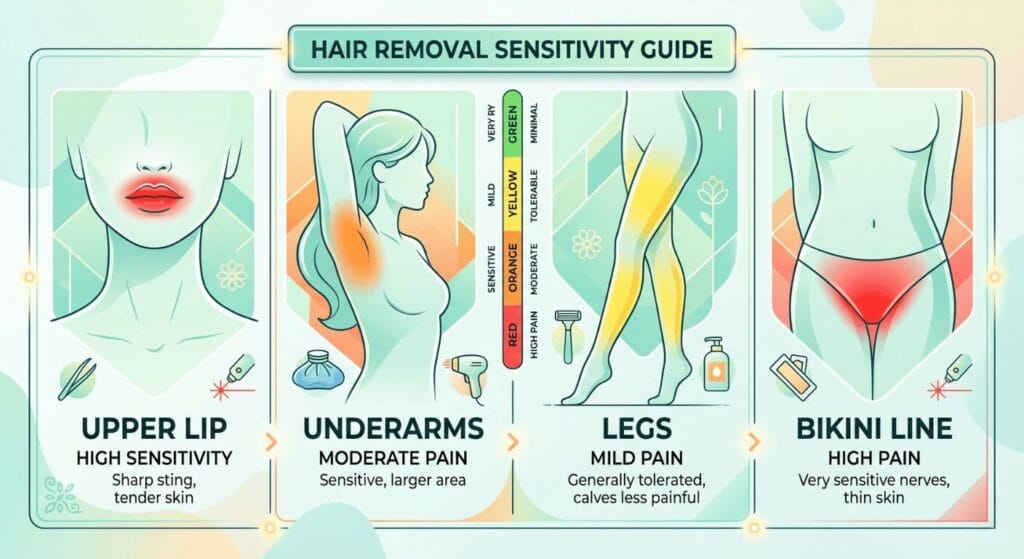
Not all body parts are created equal when it comes to laser hair removal comfort. Areas with thinner skin, more nerve endings, or denser hair follicles tend to feel more intense during treatment. Here’s a realistic breakdown:
High Sensitivity Areas
- The upper lip is widely considered the most sensitive area on the face. The skin here is extremely thin, sits close to bone, and has a dense concentration of nerve endings. Clients often describe it as a quick, sharp sting, but since the upper lip takes only seconds to treat, the discomfort is brief.
- The bikini and Brazilian area is another commonly cited high-sensitivity zone. The inner thigh and groin skin is delicate, and the hair in this region is typically coarser, which means the laser has to work harder.
- Underarms can also be surprisingly sensitive for some clients despite the relatively small treatment area, largely because of the concentration of sweat glands and lymph nodes nearby.
Moderate Sensitivity Areas
- The legs, back, and chest generally fall into the moderate range. These are larger surface areas with thicker skin, so most clients tolerate these sessions well.
- The shoulders and arms are considered among the least uncomfortable areas to treat.
Lower Sensitivity Areas
- The forehead and cheeks, when treated for facial hair, tend to be quite mild. The skin here is thicker compared to the upper lip, and the hair is typically finer.
Quick Body Area Pain Reference
| Body Area | Pain Level (1-10) | Notes |
|---|---|---|
| Upper lip | 6-8 | Thin skin, dense nerve endings |
| Bikini/Brazilian | 6-8 | Delicate skin, coarse hair |
| Underarms | 4-6 | Nerve-dense area, small zone |
| Legs | 3-5 | Larger area, thicker skin |
| Back/Chest | 3-5 | Variable, usually well-tolerated |
| Arms/Shoulders | 2-4 | Generally the most comfortable |
| Cheeks/Forehead | 2-3 | Mild, thicker facial skin |
How Skin Type Affects Pain Levels
Skin type plays a major role in both the comfort and the safety of laser hair removal. The Fitzpatrick Scale, which runs from Type I (very fair) to Type VI (very dark), helps providers select the right device and energy settings for each client.
Fair to Medium Skin (Fitzpatrick I-III)
Clients with fair to medium complexions typically experience the most comfortable sessions when treated with an Alexandrite or Diode laser. These devices are highly effective on lighter skin because the contrast between the darker hair pigment and lighter skin makes targeting more precise. Less energy scatter means less heat hitting surrounding skin, which translates to less discomfort.
Olive to Dark Skin (Fitzpatrick IV-VI)
Clients with olive, brown, or dark skin tones require more careful calibration. Because their skin contains more melanin, there’s a higher chance of the laser being absorbed by the surrounding skin rather than just the hair follicle. This is why we always use longer-wavelength devices, specifically the Nd:YAG laser for darker skin tones. The longer wavelength bypasses surface melanin and targets the follicle more precisely, reducing both the risk of burns and the overall discomfort. That said, darker skin clients may still experience a slightly more intense sensation than lighter skin clients at comparable energy settings.
Coarse vs. Fine Hair
Hair texture matters too. Coarser hair absorbs more laser energy, which means the heat generated at the follicle is higher. This can intensify the sensation slightly. Fine, vellus hair, think peach fuzz on the face, requires less energy and therefore tends to be a more comfortable treatment.
Numbing Options: How to Make Your Session More Comfortable
Discomfort during laser hair removal is very manageable, and there are several proven ways to reduce or nearly eliminate it entirely.

Topical Numbing Creams
Topical lidocaine cream is the gold standard for pre-treatment comfort. A 5% lidocaine formulation applied to the skin about 60 minutes before your session has been clinically shown to significantly reduce pain during laser procedures, even when cooling devices are already in use. Many clients who were nervous about sensitive areas like the bikini line or upper lip report that numbing cream makes those zones entirely manageable.
At Lumea Med Spa, we recommend applying numbing cream under an occlusive (airtight) dressing for maximum absorption. Your technician will clean the area thoroughly before starting the laser. It’s important that no cream residue remains on the skin when the laser fires.
Built-In Cooling Technology
Modern laser systems incorporate integrated cooling mechanisms that dramatically reduce discomfort during treatment. These include contact cooling (a chilled sapphire tip that presses against the skin just before each pulse) and dynamic cooling devices that spray a fine cryogen mist milliseconds before the laser fires. These are standard on quality devices and make a measurable difference in how sessions feel.
Over-the-Counter Pain Relievers
Taking an over-the-counter analgesic like ibuprofen or acetaminophen about 30-45 minutes before your appointment can take the edge off for clients with lower pain thresholds. This is especially useful for larger treatment areas like the back or full legs.
Pre-Session Lifestyle Adjustments
- Avoid caffeine on the day of treatment. Caffeine increases skin sensitivity and can make the sensation feel more intense.
- Hydrate well in the hours before your session.
- For clients who menstruate, scheduling sessions away from premenstrual and menstrual days is wise because hormonal fluctuations during those periods can increase sensitivity.
- Shave the treatment area the day before. Shorter hair reduces the energy required and minimizes surface-level discomfort.
Technician Technique and Pacing
An experienced, skilled technician can significantly impact your comfort level. Good pacing, adjusting the laser speed, and the ability to adapt settings in real time based on your feedback all matter. At Lumea Med Spa, our providers communicate throughout every session, checking in on your comfort and adjusting as needed.
Device Differences: Not All Lasers Feel the Same
The type of laser device used has a direct impact on how much or how little discomfort you experience. Understanding the main technologies helps you have an informed conversation with your provider.
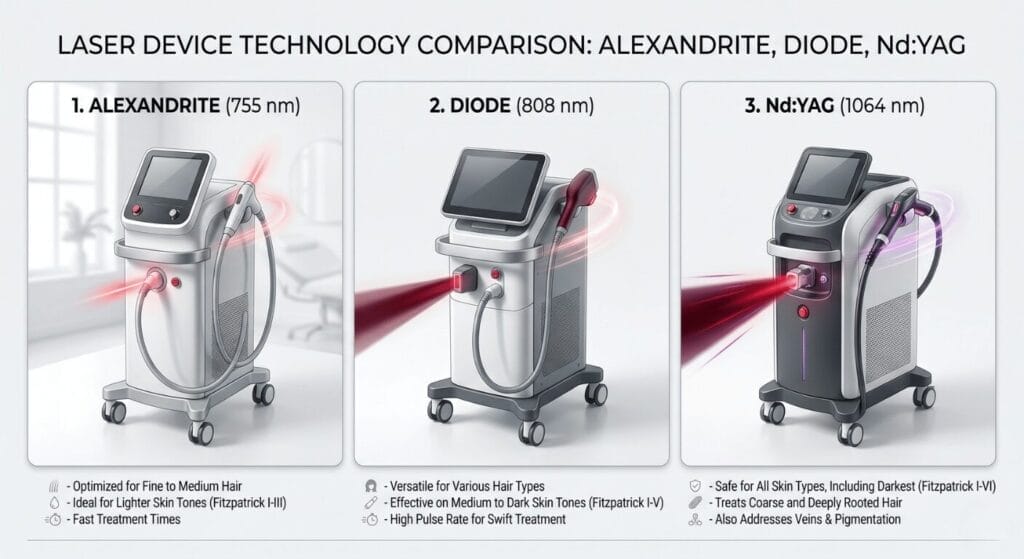
Alexandrite Laser (755 nm)
The Alexandrite laser operates at a 755-nanometer wavelength, making it exceptionally effective on lighter skin tones (Fitzpatrick I-III). It covers large surface areas quickly and is often cited as the most efficient laser for fair-skinned clients. Research published in PubMed has noted that the 800 nm diode laser can cause greater discomfort than the Alexandrite in some comparisons, though both respond well to topical lidocaine. The Alexandrite may feel mildly more intense than a Diode due to its higher energy levels, but its speed through large areas means total session time (and therefore total discomfort time) is reduced.
Diode Laser (800-810 nm)
The Diode laser sits in the middle ground, effective on both lighter and moderately dark skin tones, and generally considered comfortable. Its longer wavelength compared to the Alexandrite allows it to penetrate slightly deeper while minimizing surface skin involvement. Clinical studies comparing Alexandrite and Diode systems note that topical 5% lidocaine is effective at reducing pain for both, though neither eliminates sensation entirely. The Diode’s cooling features in modern systems make it a popular choice for clients who prioritize a comfortable experience.
Nd:YAG Laser (1064 nm)
The Nd:YAG laser operates at the longest wavelength of the three, allowing it to bypass the melanin in darker skin tones and target the hair follicle more precisely. This makes it the safest and most appropriate choice for Fitzpatrick types IV through VI. The Nd:YAG is consistently reported as the most uncomfortable of the three options. The deeper penetration required to bypass surface melanin means clients often feel more heat during treatment. However, because the alternative is potential burns or pigment changes from using the wrong device, the temporary added discomfort of the Nd:YAG is absolutely the right choice for darker skin clients.
IPL (Intense Pulsed Light)
Technically not a true laser, IPL uses a broad spectrum of light rather than a single focused wavelength. This makes it less precise and less effective overall, particularly on darker skin. Pain levels with IPL are variable, and because the energy is less targeted, clients may experience more surface skin sensation without the same follicle destruction efficacy. At Lumea Med Spa, we use medical-grade laser devices rather than IPL specifically because the results and safety profile are superior. For clients also exploring skin rejuvenation alongside hair removal, our laser resurfacing and chemical peel treatments are excellent complementary options.
Device Comparison at a Glance
| Device | Best For | Pain Level | Cooling Tech | Skin Types |
|---|---|---|---|---|
| Alexandrite | Light skin, large areas | Moderate | Yes | I-III |
| Diode | Light to medium skin | Low-moderate | Yes | I-IV |
| Nd:YAG | Dark skin | Moderate-high | Yes | IV-VI |
| IPL | Light skin (general) | Variable | Sometimes | I-III |
What to Expect Session by Session
Something many first-time clients don’t know: laser hair removal actually becomes more comfortable over time. As hair follicles are progressively destroyed across multiple sessions, there’s less active hair to absorb the laser energy, which means less heat generated at the skin surface and a gentler overall sensation as your treatment plan progresses.

Most clients require six to eight sessions for full results, spaced four to eight weeks apart depending on the body area and hair growth cycle. By sessions three and four, many clients report noticing a significant reduction in sensation compared to their first appointment. If you’re also curious about how laser hair removal compares to electrolysis, our in-depth guide covers both options side by side.
Aftercare and Managing Post-Treatment Sensations
After a session, it’s normal to experience some redness and mild swelling in the treated area. These are signs that the treatment worked; the follicles responded to the energy. Using a cold compress or ice pack on the treated area for 10-15 minutes provides quick relief. Avoid hot showers, saunas, or direct sun exposure for 24-48 hours post-treatment.
If any mild discomfort persists, over-the-counter pain relievers or a gentle, fragrance-free moisturizer can soothe the area. Any persistent burning, blistering, or unusual changes in skin texture should be reported to your provider immediately, though these outcomes are rare when treatment is performed by a licensed, experienced professional using the right device for your skin type. Clients who pair their laser treatments with our acne scar treatment or SkinPen microneedling services often find that proper post-care significantly enhances overall skin health.
Why Choosing the Right Provider Matters
Pain levels during laser hair removal are not fixed. They’re heavily influenced by who is behind the device. An inexperienced technician using incorrect settings can cause unnecessary discomfort and risk skin damage. A skilled provider at a reputable medical spa will assess your Fitzpatrick skin type, hair texture, and treatment history before selecting the appropriate device, wavelength, and energy settings for your specific needs.
At Lumea Med Spa, every laser hair removal consultation begins with a comprehensive skin assessment. We match each client to the device and protocol that gives them the best results with the highest level of comfort. Our team stays current on the latest advancements in laser technology precisely because your comfort and safety are never an afterthought. They’re the foundation of everything we do. Clients looking to complement their hair removal with other aesthetic enhancements can also explore our Botox, dermal fillers, and Morpheus8 treatments for a fully personalized aesthetic plan.

